Learn how to move from exploring data to modeling it with confidence. In this course, you’ll build and interpret linear and logistic regression models in R to uncover relationships, make predictions, and quantify uncertainty.
You’ll begin by learning how to fit and interpret simple and multiple linear regression models, then advance to modeling categorical outcomes with logistic regression. Finally, you’ll explore bootstrapping and hypothesis testing to understand and communicate the uncertainty in your results.
By the end of this course, you’ll be able to use statistical modeling to make and explain data-driven decisions – an essential skill for data scientists, analysts, and anyone working with real-world data.
Syllabus 4
Building and Interpreting Simple Linear Models 3 hours
In this module, you will learn how to describe relationships between variables using simple linear regression. You’ll practice fitting models, interpreting coefficients, and visualizing patterns to uncover meaningful insights from data. By the end of this module, you’ll know how to make predictions…
Expanding to Multiple Linear Regression 2.5 hours
Real-world data is rarely simple. In this module, you’ll extend regression modeling to include multiple predictors and interaction effects. You’ll explore how adding variables improves model accuracy, how to interpret complex relationships, and how to avoid overfitting as your models become more so…
Modeling Categorical Outcomes with Logistic Regression 3 hours
Not all outcomes are numerical. In this module, you’ll learn how to model categorical outcomes (e.g., “yes/no” or “spam/not spam”) using logistic regression. You’ll discover how to calculate probabilities, classify outcomes, and assess the performance of your models. Along the way, you’ll explore h…
Quantifying and Communicating Uncertainty 2.5 hours
Every model comes with uncertainty and understanding and communicating that uncertainty is what makes you a thoughtful data scientist. In this final module, you’ll explore bootstrapping and randomization methods to measure confidence in your results, conduct hypothesis tests, and communicate findin…
Advantages and disadvantages
Advantages
Structured courses with graded quizzes, assignments and deadlines you can reset.
A shareable certificate from the university or company when you pay.
Financial aid is often approved for students in India (apply 15 days before you need it).
From Duke University, a well-regarded name.
Self-paced: start any time.
A clear syllabus (4 parts) you can see before you start.
Disadvantages
Paid after a 7-day free trial (Coursera Plus or per course).
Some courses can be audited for free, but graded work and certificates need payment.
Some points apply to every course of this kind; see how we rank.
This course is paid. Here is how to take it for free
Free trials: You can start a 7-day free trial for many individual courses, Specializations, or a Coursera Plus subscription to test full course features. Cancel before the seventh day if you do not want to be charged.
Financial aid: If you cannot afford the fee for a certificate, you can apply for financial aid through the link on the course home page by filling out an application about your background and goals.
Taught by
Mine Çetinkaya-RundelAssociate Professor of the Practice, Department of Statistical Science
This is CS50P, CS50's Introduction to Programming with Python. Register for free at https://cs50.edx.org/python. Slides and source code at https://cs50.harvard.edu/python. Playlist at https://www.youtube.com/playlist?list=PLhQjrBD2T3817j24-GogXmWqO5Q5vYy0V. An introduction to programming using a la…
Instructor: Ana Bell View the complete course: https://ocw.mit.edu/courses/6-100l-introduction-to-cs-and-programming-using-python-fall-2022/ *Note: Lectures 6, 10 have been updated! This subject is aimed at students with little to no programming experience. It aims to provide students with an under…
This is CS50W, CS50's Web Programming with Python and JavaScript. Register for free at https://cs50.edx.org/web. Slides and source code at https://cs50.harvard.edu/web. This course picks up where Harvard University’s CS50 leaves off, diving more deeply into the design and implementation of web apps…
This course explores the concepts and algorithms at the foundation of modern artificial intelligence, diving into the ideas that give rise to technologies like game-playing engines, handwriting recognition, and machine translation. Through hands-on projects, students gain exposure to the theory beh…
This course explores the concepts and algorithms at the foundation of modern artificial intelligence, diving into the ideas that give rise to technologies like game-playing engines, handwriting recognition, and machine translation. Through hands-on projects, students gain exposure to the theory beh…
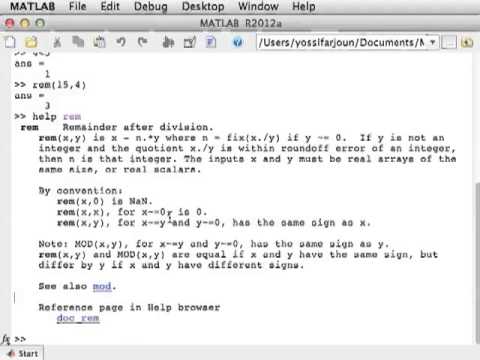
View the complete course: http://ocw.mit.edu/18-S997F11 Instructor: Yossi Farjoun This course is intended to assist undergraduates with learning the basics of programming in general and programming MATLAB® in particular. License: Creative Commons BY-NC-SA More information at http://ocw.mit.edu/term…