Geotechnical Engineering-II, a follow up course of GE-I and broadly designed to help students getting a better picture of practice of geotechnical Engineering to solve the real-life problem. Also this course is highly recommended for practicing consultants and engineers.
Syllabus 12
Week 1
Lecture 1 : Introduction
Lecture 2 : Shear Strength of soils I
Lecture 3 : Shear Strength of soils II
Lecture 4 : Shear Strength of soils III
Lecture 5 : Shear Strength of soils IV
Week 2
Lecture 6 : Testing for shear strength parameters: Introduction
Lecture 7 : Direct shear box test
Lecture 8 : Direct Shear Interpretation of Test Results I
Lecture 9 : Direct Shear Interpretation of Test Results II
Lecture 10 : Kf line
Week 3
Lecture 11 : Selection of Parameter (Shear Strength ,SS) I
Lecture 12 : Selection of Parameter (Shear Strength ,SS) II
Lecture 13 : Shear Strength of Cohesive Soils
Lecture 14 : Shear Strength of Cohesive Soils II
Week 4
Lecture 15 : Triaxial Test
Lecture 16 : Triaxial Test II
Lecture 17 : Triaxial Test III
Lecture 18 : Interpretation of Triaxial test Results
Week 5
Lecture 19 : Interpretation of Triaxial test Results II
Lecture 20 : Interpretation of Triaxial test Results III
Lecture 21 : Pore Pressure Parameters
Lecture 22 : Pore Pressure Parameters II
Week 6
Lecture 23 : Stress Paths
Lecture 24 : Stress Paths II
Lecture 25 : Plastic Equilibrium in Soils
Lecture 26 : Mechanisms of Development of Plastic Equilibrium in Soils
Week 7
Lecture 27 : Mechanisms of Development of Plastic Equilibrium in Soils II
Lecture 28 : Earth Pressure Analysis (Trial Wedge) I
Lecture 29 : Earth Pressure Analysis (Trial Wedge) II
Lecture 30 : Earth Pressure Analysis (Trial Wedge) III
Week 8
Lecture 31 : Analysis of Completely Submerged Retaining wall
Lecture 32 : Gravity Walls Supporting Cohesive Soil Mass (Backfill)
Instructor: Dennis Freeman, Kendra Pugh This course provides an integrated introduction to electrical engineering and computer science, including modern software engineering, linear systems analysis, electronic circuits, and decision-making. The lecture videos provide an overview of each topic, whi…
Instructor: Russell Tedrake See the complete course at: http://ocw.mit.edu/6-832s09 Robots today move far too conservatively, using control systems that attempt to maintain full control authority at all times. Humans and animals move much more aggressively by routinely executing motions which invol…
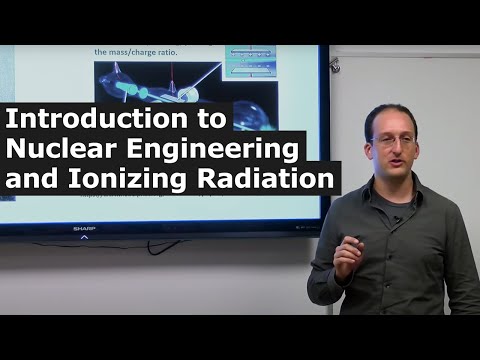
Instructor: Michael Short View the complete course: https://ocw.mit.edu/22-01F16 This course provides an introduction to nuclear science and its engineering applications. It describes basic nuclear models, radioactivity, nuclear reactions and kinematics; covers the interaction of ionizing radiation…
Instructor: David Perreault View the complete course: https://ocw.mit.edu/courses/6-622-power-electronics-spring-2023 YouTube Playlist: https://www.youtube.com/playlist?list=PLUl4u3cNGP62UTc77mJoubhDELSC8lfR0 6.622 covers modeling, analysis, design, control, and application of circuits for energy c…
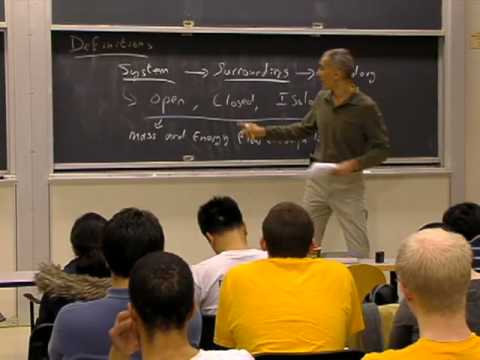
Instructors: Moungi Bawendi, Keith Nelson This subject deals primarily with equilibrium properties of macroscopic systems, basic thermodynamics, chemical equilibrium of reactions in gas and solution phase, and rates of chemical reactions. View the complete course at: http://ocw.mit.edu/5-60S08 Lice…