The Internet of Things (IoT) stands to be the next revolution in computing. Billions of data-spouting devices connected to the Internet are already fundamentally changing the way we live and work. This course teaches a deep understanding of IoT technologies from the ground up. Students will learn IoT device programming (Arduino and Raspberry Pi), sensing and actuating technologies, IoT protocol stacks (Zigbee, 5G, NFC, MQTT, etc), networking backhaul design and security enforcement, data science for IoT, and cloud-based IoT platforms such as AWS IoT. As an optional honors avtivity, students will be guided through laboratory assignments designed to give them practical real-world experience, where they will deploy a distributed wifi monitoring service, a cloud-based IoT service platform serving tens of thousands of heartbeat sensors, and more. Students will emerge from the class with a cutting-edge education on this rapidly emerging technology segment, and with the confidence to carry out tasks they will commonly encounter in industrial settings. Important: To complete the practical part of the whole series (honors) there will be practical experimentation using actual hardware, which you will need to acquire. (Cost may vary between 100 and 200 USD depending on your location). Most parts that are needed for the first course, will be re-used in the following courses.
Syllabus 4
Week 1: Orientation, Basics and Lab instructions 3.5 hours
Welcome to our first course on Internet of Things! You will become familiar with the course and our learning environment. The orientation will also help you obtain the technical skills required to navigate the course. In this week you'll see that The Internet of Things is amazing, but it's not like…
Week 2 - Devices: IoT circuits 2.5 hours
In this week we will describe the foundational notions of electricity and IoT circuits you will need to build real IoT devices. We will start off by describing what electricity is and how it flows through electronics. We will present what electronic components are out there, how to choose the set y…
Week 3 - IoT Devices Architecture 3.5 hours
In computing, we have the concept of architecture as well. You don't just design computing systems. In this module, you will learn about how IoT systems are architected. We will start off by describing the higher-level components used to build IoT systems such as ICs and breakout modules. We will p…
In this week, we will study the design of IoT platforms - how their components are assembled together, and how software running on top orchestrates their actions to perform their intended purpose. We'll also collect your submission of the lab project you started in week 1.
Structured courses with graded quizzes, assignments and deadlines you can reset.
A shareable certificate from the university or company when you pay.
Financial aid is often approved for students in India (apply 15 days before you need it).
From University of Illinois Urbana-Champaign, a well-regarded name.
Rated 4.7 out of 5 by 531 learners.
Self-paced: start any time.
A clear syllabus (4 parts) you can see before you start.
Hands-on: you build or practise, not just watch.
Disadvantages
Paid after a 7-day free trial (Coursera Plus or per course).
Some courses can be audited for free, but graded work and certificates need payment.
Some points apply to every course of this kind; see how we rank.
This course is paid. Here is how to take it for free
Free trials: You can start a 7-day free trial for many individual courses, Specializations, or a Coursera Plus subscription to test full course features. Cancel before the seventh day if you do not want to be charged.
Financial aid: If you cannot afford the fee for a certificate, you can apply for financial aid through the link on the course home page by filling out an application about your background and goals.
This is CS50P, CS50's Introduction to Programming with Python. Register for free at https://cs50.edx.org/python. Slides and source code at https://cs50.harvard.edu/python. Playlist at https://www.youtube.com/playlist?list=PLhQjrBD2T3817j24-GogXmWqO5Q5vYy0V. An introduction to programming using a la…
Instructor: Ana Bell View the complete course: https://ocw.mit.edu/courses/6-100l-introduction-to-cs-and-programming-using-python-fall-2022/ *Note: Lectures 6, 10 have been updated! This subject is aimed at students with little to no programming experience. It aims to provide students with an under…
This is CS50W, CS50's Web Programming with Python and JavaScript. Register for free at https://cs50.edx.org/web. Slides and source code at https://cs50.harvard.edu/web. This course picks up where Harvard University’s CS50 leaves off, diving more deeply into the design and implementation of web apps…
This course explores the concepts and algorithms at the foundation of modern artificial intelligence, diving into the ideas that give rise to technologies like game-playing engines, handwriting recognition, and machine translation. Through hands-on projects, students gain exposure to the theory beh…
This course explores the concepts and algorithms at the foundation of modern artificial intelligence, diving into the ideas that give rise to technologies like game-playing engines, handwriting recognition, and machine translation. Through hands-on projects, students gain exposure to the theory beh…
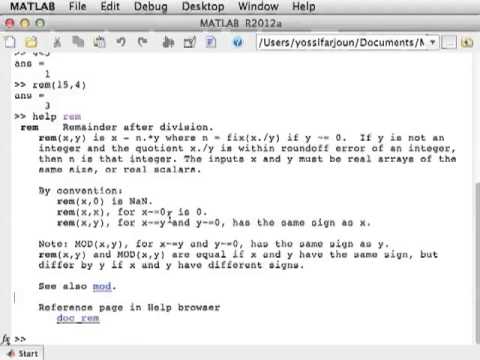
View the complete course: http://ocw.mit.edu/18-S997F11 Instructor: Yossi Farjoun This course is intended to assist undergraduates with learning the basics of programming in general and programming MATLAB® in particular. License: Creative Commons BY-NC-SA More information at http://ocw.mit.edu/term…