Welcome to this 2 hour long guided project on creating and training an Object Localization model with TensorFlow. In this guided project, we are going to use TensorFlow's Keras API to create a convolutional neural network which will be trained to classify as well as localize emojis in images. Localization, in this context, means the position of the emojis in the images. This means that the network will have one input and two outputs. Think of this task as a simpler version of Object Detection. In Object Detection, we might have multiple objects in the input images, and an object detection model predicts the classes as well as bounding boxes for all of those objects. In Object Localization, we are working with the assumption that there is just one object in any given image, and our CNN model will classify and localize that object.
Please note that you will need prior programming experience in Python. You will also need familiarity with TensorFlow. This is a practical, hands on guided project for learners who already have theoretical understanding of Neural Networks, Convolutional Neural Networks, and optimization algorithms like Gradient Descent but want to understand how to use use TensorFlow to solve computer vision tasks like Object Localization.
Advantages and disadvantages
Advantages
Structured courses with graded quizzes, assignments and deadlines you can reset.
A shareable certificate from the university or company when you pay.
Financial aid is often approved for students in India (apply 15 days before you need it).
Self-paced: start any time.
Disadvantages
Paid after a 7-day free trial (Coursera Plus or per course).
Some courses can be audited for free, but graded work and certificates need payment.
Some points apply to every course of this kind; see how we rank.
This course is paid. Here is how to take it for free
Free trials: You can start a 7-day free trial for many individual courses, Specializations, or a Coursera Plus subscription to test full course features. Cancel before the seventh day if you do not want to be charged.
Financial aid: If you cannot afford the fee for a certificate, you can apply for financial aid through the link on the course home page by filling out an application about your background and goals.
Led by Andrew Ng, this course provides a broad introduction to machine learning and statistical pattern recognition. Topics include: supervised learning (generative/discriminative learning, parametric/non-parametric learning, neural networks, support vector machines); unsupervised learning (cluster…
This course explores the world of Transformers and Large Language Models (LLMs). You will learn the evolution of NLP methods, the core components of the Transformer architecture, along with how they relate to LLMs as well as techniques to enhance model performance for real-world applications. Throu…
Dive into the intriguing world of AI Transformers with this curated YouTube playlist. Featuring expert insights, educational content from leading organizations, and engaging discussions, this playlist keeps you informed about the latest breakthroughs in Transformer technology.
Stanford CS25: Transformers United Since their introduction in 2017, transformers have revolutionized Natural Language Processing (NLP). Now, transformers are finding applications all over Deep Learning, be it computer vision (CV), reinforcement learning (RL), Generative Adversarial Networks (GANs)…
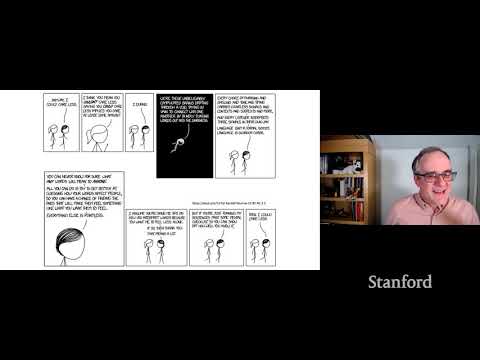
Natural language processing (NLP) is a crucial part of artificial intelligence (AI), modeling how people share information. In recent years, deep learning approaches have obtained very high performance on many NLP tasks. In this course, students gain a thorough introduction to cutting-edge neural n…