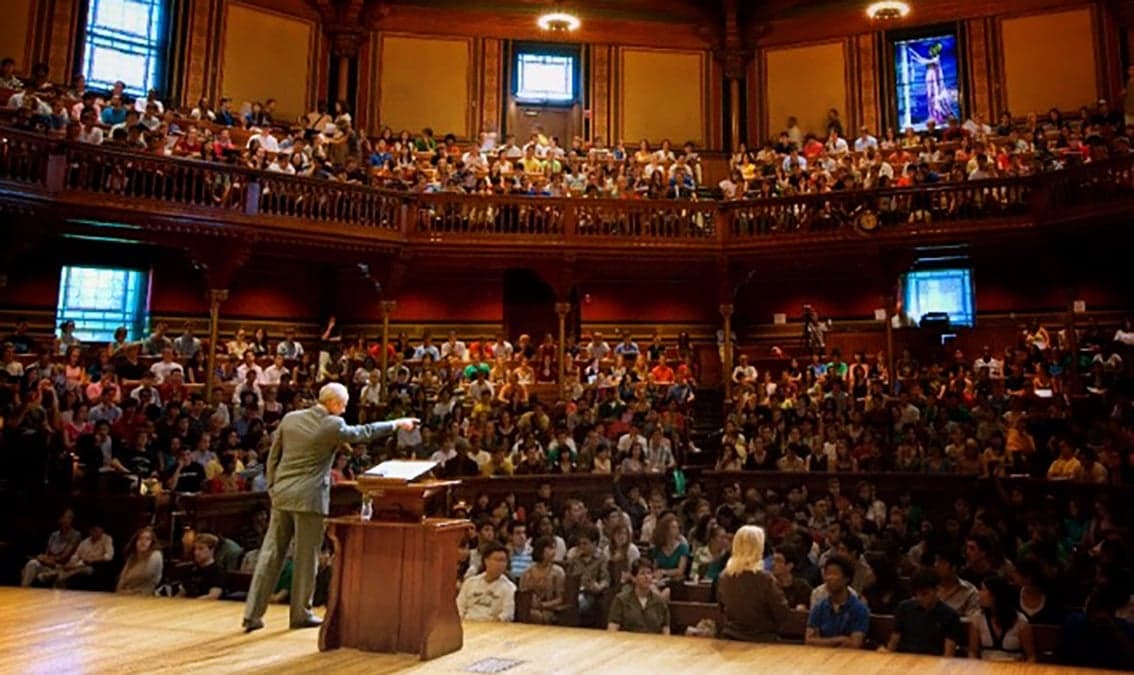
This course in organizational economics prepares doctoral students for further study in the field. The course introduces the classic papers and some recent research. The material is organized into the following modules: boundaries of the firm, employment in organizations, decision-making in organizations, and structures and processes in organizations. Each class session covers a few leading papers.
This course was joint-taught between faculty of the Massachusetts Institute of Technology and Harvard University. The Harvard course is Economics 2670 Organizational Economics.
Instructor: Dennis Freeman, Kendra Pugh This course provides an integrated introduction to electrical engineering and computer science, including modern software engineering, linear systems analysis, electronic circuits, and decision-making. The lecture videos provide an overview of each topic, whi…
This playlist contains video recordings of Stanford's graduate-level CS329A course. It covers the latest techniques and applications of AI agents that can continuously improve themselves through interaction with themselves and the environment. The lecture recordings start with self-improvement tech…
The field of Computer Science is headed for a major upheaval with the rise of large AI models, such as ChatGPT, that are capable of performing general-purpose reasoning and problem solving. We are headed for a future in which it will no longer be necessary to write computer programs. Rather, I beli…
Instructor: Jon Gruber, 14.01 students View the complete course: http://ocw.mit.edu/14-01SCF10 This course includes a full set of lecture videos and a selection of problem solving videos. In the lecture videos, Professor Jonathan Gruber covers the principles of microeconomics conceptually, mathemat…
This course provides a thorough introduction to the principles and methods of physics for students who have good preparation in physics and mathematics. Emphasis is placed on problem solving and quantitative reasoning. This course covers Newtonian mechanics, special relativity, gravitation, thermod…