This course introduces state-of-the-art concepts and practices in Remote Sensing and GIS. Beginning with fundamental principles, it progresses to advanced methodologies, equipping students with a comprehensive understanding of their application in research problem-solving. Upon completion, participants will be able to effectively utilize remote sensing (satellite imagery and field data) and GIS in their future research endeavors.
INTENDED AUDIENCE : B.Tech, M.S., M.S.R., M.Sc., M.Tech., Ph.D. and ProfessionalsINDUSTRY SUPPORT : Esri, Rolta India, RMSI Private Limited, ArcGeosystems
Syllabus 8
Week 1 : Remote Sensing Data and Corrections
Lec 1 : Overview and Introduction
Lec 2 : Basics of Remote Sensing
Lec 3 :Error corrections in satellite image
Week 2
Lec 4: Error Identification and Correction-I
Lec 5: Error Identification and Correction-II
Lec 6: Error Identification and Correction-III
Week 3
Lec 7: DIP-I
Lec 8: DIP-II
Lec 9: DIP-III
Week 4
Lec 10: DIP-IV
Lec 11: Image Classification-I
Lec 12: Image Classification-II
Week 5: Thermal and Microwave
Lec 13: Photogrammetry
Lec 14: Thermal Remote Sensing
Lec 15: Microwave Remote Sensing
Week 6: Imaging Spectroscopy-I
Lec 16: HRS-I
Lec 17: HRS-II
Lec 18: HRS-III
Week 7: Imaging Spectroscopy-II & GIS-I
Lec 19: HRS-IV
Lec 20: HRS-V
Lec 21: GIS-I
Week 8 : GIS-II and Application
Lec 22: GIS-II
Lec 23: Applications of Remote Sensing & GIS-I
Lec 24: Applications of Remote Sensing & GIS-II
Advantages and disadvantages
Advantages
Taught by IIT and IISc professors, and it follows the Indian university syllabus closely.
All videos and assignments are free on NPTEL and SWAYAM.
The certificate is recognised by many Indian universities for credit transfer and by GATE aspirants.
Great for GATE and semester exam preparation.
From Indian Institute of Technology Guwahati, a well-regarded name.
Completely free.
Self-paced: start any time.
A clear syllabus (8 parts) you can see before you start.
Disadvantages
The certificate needs a proctored exam at a centre, which has a fee.
Recorded classroom lectures: thorough, but slower than made-for-online courses.
New runs start on fixed dates (January and July).
Learning is free, but the certificate costs money.
Some points apply to every course of this kind; see how we rank.
Free to learn
Free: Every video and assignment is free on NPTEL and SWAYAM. Enrol when the next run opens.
Certificate: Optional. It needs a proctored exam at a centre, which has a fee.
Instructor: Dennis Freeman, Kendra Pugh This course provides an integrated introduction to electrical engineering and computer science, including modern software engineering, linear systems analysis, electronic circuits, and decision-making. The lecture videos provide an overview of each topic, whi…
Instructor: Russell Tedrake See the complete course at: http://ocw.mit.edu/6-832s09 Robots today move far too conservatively, using control systems that attempt to maintain full control authority at all times. Humans and animals move much more aggressively by routinely executing motions which invol…
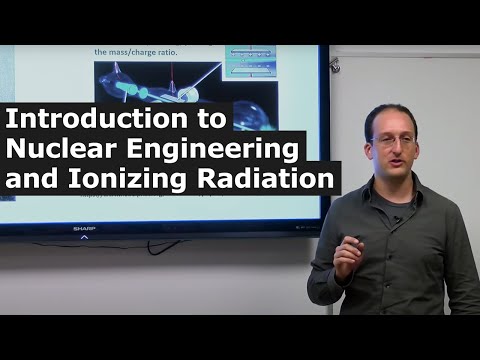
Instructor: Michael Short View the complete course: https://ocw.mit.edu/22-01F16 This course provides an introduction to nuclear science and its engineering applications. It describes basic nuclear models, radioactivity, nuclear reactions and kinematics; covers the interaction of ionizing radiation…
Instructor: David Perreault View the complete course: https://ocw.mit.edu/courses/6-622-power-electronics-spring-2023 YouTube Playlist: https://www.youtube.com/playlist?list=PLUl4u3cNGP62UTc77mJoubhDELSC8lfR0 6.622 covers modeling, analysis, design, control, and application of circuits for energy c…
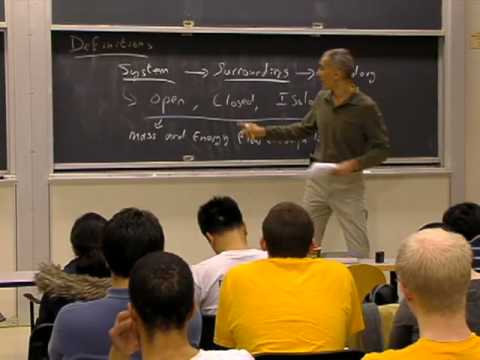
Instructors: Moungi Bawendi, Keith Nelson This subject deals primarily with equilibrium properties of macroscopic systems, basic thermodynamics, chemical equilibrium of reactions in gas and solution phase, and rates of chemical reactions. View the complete course at: http://ocw.mit.edu/5-60S08 Lice…