Data visualization is a critical skill for anyone that routinely using quantitative data in his or her work - which is to say that data visualization is a tool that almost every worker needs today. One of the critical tools for data visualization today is the R statistical programming language. Especially in conjunction with the tidyverse software packages, R has become an extremely powerful and flexible platform for making figures, tables, and reproducible reports. However, R can be intimidating for first time users, and there are so many resources online that it can be difficult to sort through without guidance.
This is the final course in the Specialization "Data Visualization and Dashboarding in R." Learners in this course will enter with a well-developed set of skills making a wide variety of visualizations in R. The focus on this course will applying those skills to a unique project, drawing on publicly available data to tell a compelling story using the data visualization toolkit assembled in the previous courses.
Syllabus 3
Developing Your Eye and Finding Data 6 hours
In this module, we will review the requirements for the capstone project and some possible souces for data. Then, we have a very fast overview of resources on good data visualization practice.
Cleaning Your Data 6.5 hours
In this module, we will review the requirements for the second component of your capstone project, where you will demonstrate that your data is ready for visualization. Then, we (re)introduce some important tools for cleaning data in R.
Making Your Report 9 hours
In this module, you will do one more visualization critique, and the rest of your time in the week should be devoted to finishing your capstone project.
Structured courses with graded quizzes, assignments and deadlines you can reset.
A shareable certificate from the university or company when you pay.
Financial aid is often approved for students in India (apply 15 days before you need it).
Taught by Johns Hopkins University, one of the strongest names in its field.
Self-paced: start any time.
A clear syllabus (3 parts) you can see before you start.
Hands-on: you build or practise, not just watch.
Disadvantages
Paid after a 7-day free trial (Coursera Plus or per course).
Some courses can be audited for free, but graded work and certificates need payment.
Some points apply to every course of this kind; see how we rank.
This course is paid. Here is how to take it for free
Free trials: You can start a 7-day free trial for many individual courses, Specializations, or a Coursera Plus subscription to test full course features. Cancel before the seventh day if you do not want to be charged.
Financial aid: If you cannot afford the fee for a certificate, you can apply for financial aid through the link on the course home page by filling out an application about your background and goals.
Taught by
Collin PaschallSenior Lecturer, Johns Hopkins University Center for Advanced Governmental Studies
This is CS50P, CS50's Introduction to Programming with Python. Register for free at https://cs50.edx.org/python. Slides and source code at https://cs50.harvard.edu/python. Playlist at https://www.youtube.com/playlist?list=PLhQjrBD2T3817j24-GogXmWqO5Q5vYy0V. An introduction to programming using a la…
Instructor: Ana Bell View the complete course: https://ocw.mit.edu/courses/6-100l-introduction-to-cs-and-programming-using-python-fall-2022/ *Note: Lectures 6, 10 have been updated! This subject is aimed at students with little to no programming experience. It aims to provide students with an under…
This is CS50W, CS50's Web Programming with Python and JavaScript. Register for free at https://cs50.edx.org/web. Slides and source code at https://cs50.harvard.edu/web. This course picks up where Harvard University’s CS50 leaves off, diving more deeply into the design and implementation of web apps…
This course explores the concepts and algorithms at the foundation of modern artificial intelligence, diving into the ideas that give rise to technologies like game-playing engines, handwriting recognition, and machine translation. Through hands-on projects, students gain exposure to the theory beh…
This course explores the concepts and algorithms at the foundation of modern artificial intelligence, diving into the ideas that give rise to technologies like game-playing engines, handwriting recognition, and machine translation. Through hands-on projects, students gain exposure to the theory beh…
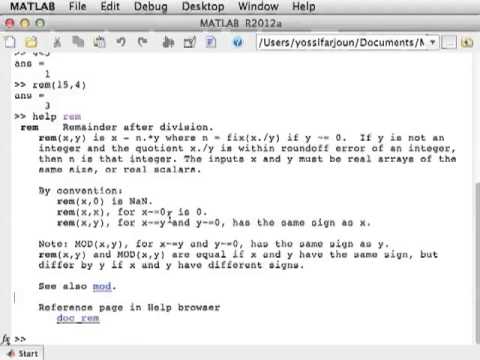
View the complete course: http://ocw.mit.edu/18-S997F11 Instructor: Yossi Farjoun This course is intended to assist undergraduates with learning the basics of programming in general and programming MATLAB® in particular. License: Creative Commons BY-NC-SA More information at http://ocw.mit.edu/term…