From theory to application, this course guides you through supervised learning essentials. Learn to select, implement, and refine models that solve complex classification and regression tasks.
Syllabus 10
Introduction to Supervised Learning
Before diving into the many algorithms of machine learning, it is important to take a step back and understand the big picture associated with the entire field.
Linear Regression
Linear regression is one of the most fundamental algorithms in machine learning. In this lesson, learn how linear regression works!
Perceptron Algorithm
The perceptron algorithm is an algorithm for classifying data. It is the building block of neural networks.
Decision Trees
Decision trees are a structure for decision-making where each decision leads to a set of consequences or additional decisions.
Naive Bayes
Naive Bayesian Algorithms are powerful tools for creating classifiers for incoming labeled data. Specifically Naive Bayes is frequently used with text data and classification problems.
Support Vector Machines
Support vector machines are a common method used for classification problems. They have been proven effective using what is known as the 'kernel' trick!
Ensemble Methods
Bagging and boosting are two common ensemble methods for combining simple algorithms to make more advanced models that work better than the simple algorithms would on their own.
Model Evaluation Metrics
Learn the main metrics to evaluate models, such as accuracy, precision, recall, and more!
Training and Tuning
Learn the main types of errors that can occur during training, and several methods to deal with them and optimize your machine learning models.
Finding Donors Project
You've covered a wide variety of methods for performing supervised learning -- now it's time to put those into action!
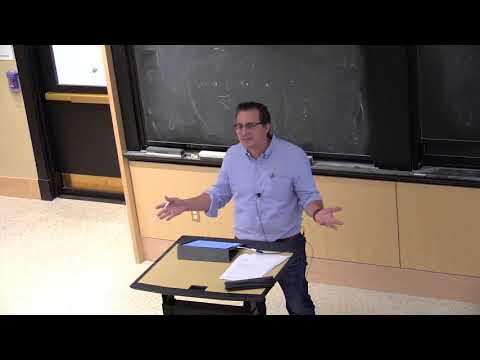
MIT 18.650 Statistics for Applications, Fall 2016 View the complete course: http://ocw.mit.edu/18-650F16 Instructor: Philippe Rigollet This course offers an in-depth the theoretical foundations for statistical methods that are useful in many applications. The goal is to understand the role of mathe…
This is an introductory-level course in supervised learning, with a focus on regression and classification methods. The syllabus includes: linear and polynomial regression, logistic regression and linear discriminant analysis; cross-validation and the bootstrap, model selection and regularization m…
This is an introductory-level course in supervised learning, with a focus on regression and classification methods. The syllabus includes: linear and polynomial regression, logistic regression and linear discriminant analysis; cross-validation and the bootstrap, model selection and regularization m…